


U-values adjustment to rainscreen subframes
How are U-values adjusted to account for rainscreen subframes?
Written by David Fraser, Rainscreen System - Business Unit Manager in SFS Group Fastening Technology Ltd.
Thermal transmittances, or U-values, calculated for external walls with a rainscreen facade must be corrected in accordance with BRE Report (BR) 443, to take account of the thermal bridging effect of the rainscreen subframe system.
A separate blog post looks at how most U-values are calculated using the combined method, which is a simplified form of calculation. This post considers how the combined method is not sophisticated enough to account for the complex heat transfer through a subframe’s helping hand brackets, and what options are available instead to ensure accurate heat loss calculations.

How does BR 443 adjust U-value calculations for rainscreen subframes?
BR 443 is a document describing industry conventions that should be used when calculating U-values. At the time of writing, the most recent version is the 2019 edition. Any construction professional who frequently works with U-values should have an understanding of BR 443.
It offers three routes by which a rainscreen subframe can be accounted for. The first is to carry out a detailed calculation for the complete wall build-up, thereby not using the combined method at all.
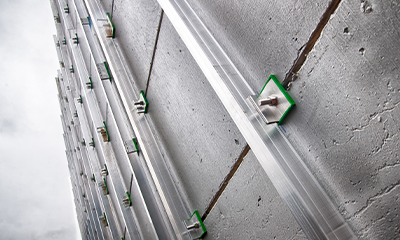
An alternative is to calculate a point thermal transmittance for any fixing bracket that penetrates an insulation layer (or a linear thermal transmittance for a fixing rail). This means the thermal performance of the bracket is modelled using a detailed calculation procedure, and its effect applied to a combined method calculation for the rest of the wall.

The final option is to calculate the U-value of the wall without any account of the fixings, and apply a default correction as given in the standard. The default correction heavily penalises the final U-value result and is not feasible for projects where low U-values need to be achieved.
It is clear, therefore, that some form of detailed calculation is required to ensure that a subframe’s impact on the external wall’s thermal performance is accounted for accurately. The subframe and insulation specification can then be optimised to deliver the most cost-effective solution without over-specifying bracket sizes and insulation thicknesses.
SFS are NOT thermal engineers, however we can make recommendations based on the point loss (chi value) of our subframe bracket systems.
SFS’s Project Builder tool provides tailored solutions for rainscreen facade projects, including point thermal transmittances for helping hand brackets. It helps specifiers to find the optimal thermal solution to meet a project’s U-value requirements.

Frequently Asked Questions...
Why do U-values need adjustment for rainscreen subframes?
Standard U-value calculations do not fully account for thermal bridging caused by rainscreen subframe brackets penetrating insulation. Adjustments are required to accurately reflect additional heat loss and true external wall performance.
What is BR 443 and how does it affect U-value adjustment for rainscreen subframes?
BRE Report 443 (BR 443) provides guidance for adjusting U-values to account for fixings and thermal bridges. It outlines accepted approaches where subframes disrupt insulation continuity.
Can the combined method in BS EN ISO 6946 account for rainscreen subframes?
BS EN ISO 6946 includes corrections for simple fixings, but it is usually not sufficient for complex rainscreen subframe brackets. Detailed modelling is often needed for accurate adjustments.
What is point thermal transmittance (chi value) in U-value adjustment?
Point thermal transmittance (chi value, χ) measures heat loss from individual thermal bridges such as subframe brackets. Including chi values improves the accuracy of adjusted U-values.
How can detailed modelling improve U-value accuracy for rainscreen subframes?
Thermal modelling assesses the whole wall build-up, including bracket geometry and material properties, to calculate a more precise U-value rather than relying on conservative default penalties.
Are default U-value corrections suitable for high-performance façade designs?
Default corrections can heavily penalise U-values and may not reflect real performance. High-performance façades typically need project-specific modelling or chi-value based calculations for reliable results.
You might also be interested in...
U-values adjustment to rainscreen subframes
How are U-values adjusted to account for rainscreen subframes?
Written by David Fraser, Rainscreen System - Business Unit Manager in SFS Group Fastening Technology Ltd.
Thermal transmittances, or U-values, calculated for external walls with a rainscreen facade must be corrected in accordance with BRE Report (BR) 443, to take account of the thermal bridging effect of the rainscreen subframe system.
A separate blog post looks at how most U-values are calculated using the combined method, which is a simplified form of calculation. This post considers how the combined method is not sophisticated enough to account for the complex heat transfer through a subframe’s helping hand brackets, and what options are available instead to ensure accurate heat loss calculations.
How does BR 443 adjust U-value calculations for rainscreen subframes?
BR 443 is a document describing industry conventions that should be used when calculating U-values. At the time of writing, the most recent version is the 2019 edition. Any construction professional who frequently works with U-values should have an understanding of BR 443.
It offers three routes by which a rainscreen subframe can be accounted for. The first is to carry out a detailed calculation for the complete wall build-up, thereby not using the combined method at all.
An alternative is to calculate a point thermal transmittance for any fixing bracket that penetrates an insulation layer (or a linear thermal transmittance for a fixing rail). This means the thermal performance of the bracket is modelled using a detailed calculation procedure, and its effect applied to a combined method calculation for the rest of the wall.
The final option is to calculate the U-value of the wall without any account of the fixings, and apply a default correction as given in the standard. The default correction heavily penalises the final U-value result and is not feasible for projects where low U-values need to be achieved.
It is clear, therefore, that some form of detailed calculation is required to ensure that a subframe’s impact on the external wall’s thermal performance is accounted for accurately. The subframe and insulation specification can then be optimised to deliver the most cost-effective solution without over-specifying bracket sizes and insulation thicknesses.
SFS are NOT thermal engineers, however we can make recommendations based on the point loss (chi value) of our subframe bracket systems.
SFS’s Project Builder tool provides tailored solutions for rainscreen facade projects, including point thermal transmittances for helping hand brackets. It helps specifiers to find the optimal thermal solution to meet a project’s U-value requirements.
Frequently Asked Questions...
Standard U-value calculations do not fully account for thermal bridging caused by rainscreen subframe brackets penetrating insulation. Adjustments are required to accurately reflect the additional heat loss and the true thermal performance of the external wall system.
BRE Report 443 (BR 443) provides industry guidance for adjusting U-values to account for fixings and thermal bridges. It outlines accepted methods for correcting U-values where rainscreen subframes affect insulation continuity.
The combined method in BS EN ISO 6946 includes corrections for simple fixings, but it is generally insufficient for complex rainscreen subframe brackets. More detailed modelling methods are often required to achieve accurate U-value adjustments.
Point thermal transmittance, often called a chi value (χ), measures the heat loss from individual thermal bridges such as rainscreen subframe brackets. Including chi values within calculations improves the accuracy of adjusted U-values.
Detailed thermal modelling evaluates the complete wall assembly, including bracket geometry and material properties. This provides a more precise U-value without relying solely on conservative default correction penalties.
Default corrections often heavily penalise U-values and may not reflect actual performance. For high-performance façades with rainscreen subframes, project-specific modelling or point thermal transmittance calculations are typically required for reliable results.